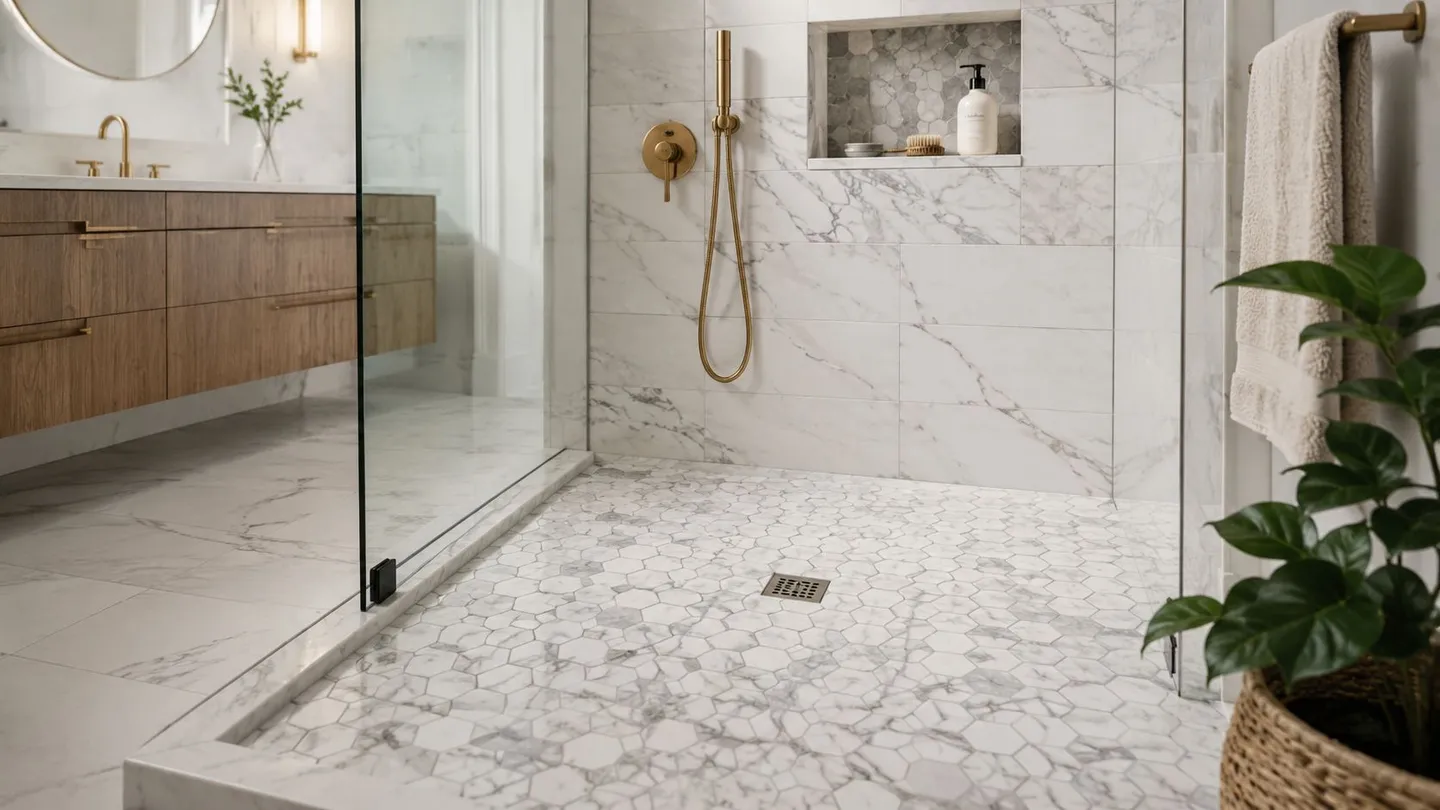
There is a moment during almost every bathroom renovation when practical decisions suddenly become design decisions. The shower floor is a perfect example. At first, it seems simple: choose a material that handles water, feels comfortable underfoot, and works with the rest of the bathroom. Then you start looking at natural stone, different mosaic patterns, grout colors, finishes, veining, and tile sizes.
Suddenly, that small section of floor matters a lot.
Choosing the right marble shower floor tile can completely change how a bathroom feels. Marble introduces natural variation that manufactured surfaces often try to imitate but rarely reproduce convincingly. Every piece carries slightly different veins, shades, mineral markings, and tonal shifts. When those pieces are arranged as mosaics, the shower floor gains depth rather than looking like one flat, repetitive surface.
But marble also demands sensible decisions. It is natural stone, not an indestructible synthetic product. The finish matters. Installation matters. Sealing and maintenance matter. Even the size of the individual mosaic pieces can affect how comfortable and practical the shower becomes.
That is precisely why choosing marble should involve more than simply asking, "Which one looks best?"
Why Marble Works So Well on Shower Floors
A shower floor has a difficult job. It needs to look attractive while accommodating drainage, moisture, frequent cleaning, and daily foot traffic.
Large-format tiles can look beautiful elsewhere in a bathroom, but shower floors normally require adequate slope toward the drain. Smaller pieces are much easier to install across these subtle changes in angle. This is one reason mosaics have become such a natural partner for shower applications.
A marble shower floor tile in a smaller mosaic format can follow the shower pan's slope while creating numerous grout joints across the surface. Those joints also contribute texture underfoot.
The visual effect is equally important.
Imagine a bathroom with large-format Carrara-style marble on the walls. Continuing exactly the same large tile onto the shower floor may make the room feel somewhat flat. Introduce a small hexagon, basketweave, herringbone, or square mosaic instead, and suddenly there is contrast without introducing another unrelated material.
The bathroom remains cohesive, but it becomes more interesting.
That balance between consistency and variation is one of marble's greatest strengths.
Choosing the Right Marble Shower Floor Tile
Not every marble product should automatically be treated as interchangeable. Color gets most of the attention, but several other characteristics deserve consideration.
Honed or Polished?
One of the first decisions involves finish.
Polished marble has a reflective surface that emphasizes color and veining. It can look dramatic on walls, backsplashes, vanity surrounds, and decorative areas. Honed marble has a softer, more matte appearance.
For a marble shower floor tile, many homeowners and designers prefer a honed finish because the understated surface feels particularly natural in wet areas and generally provides a different underfoot character than highly polished stone.
That doesn't mean polished marble has no place in bathroom design. Quite the opposite. A useful strategy can be to mix finishes while keeping the stone consistent.
For example:
• honed marble mosaic on the shower floor• larger honed or polished marble tiles on the shower walls• polished marble accents inside the niche• matching stone trim around selected edges
The result feels deliberate instead of overly uniform.
Mosaic Size Deserves More Attention
People often choose mosaics according to pattern and forget about scale.
Smaller pieces create more grout lines. They can also accommodate shower-floor slopes effectively, especially around conventional drains. Larger mosaic pieces create a calmer appearance but require careful planning during installation.
Think about proportions as well.
A tiny mosaic can bring beautiful detail into a compact shower. In a very large walk-in shower, however, an extremely small pattern may become visually busy. A larger hexagon or restrained geometric design could provide a better balance.
There is no universal answer. The shower dimensions, drain position, surrounding tile, and desired visual effect should all influence the decision.
Natural Variation Is a Feature, Not a Manufacturing Defect
One reason people choose real marble is also one reason inexperienced buyers sometimes hesitate after opening the boxes.
The pieces do not all look identical.
They shouldn't.
Natural marble can contain variations in veining, shade, mineral deposits, and background color. Carrara White, for example, is known for its soft white-to-gray appearance and gray veining. Calacatta varieties can create stronger contrasts, while darker stones produce an entirely different atmosphere.
This is why dry laying material before permanent installation can be valuable.
Open several boxes. Place the sheets or tiles together. Look at the overall distribution.
If one sheet contains noticeably stronger veining, you may decide to position it intentionally rather than allowing it to land randomly in the most visible part of the shower.
A good installer might say:
"Don't install natural stone box by box. Mix the pieces first and design the variation."
That simple approach can make the finished surface look far more balanced.
Marble Shower Floor Tile vs. Porcelain: The Real Trade-Off
Porcelain deserves respect. It is durable, widely available, relatively easy to maintain, and modern printing technology can create convincing stone-inspired surfaces.
So why choose real marble?
Because imitation and natural material create different experiences.
Porcelain repeats a manufactured design. Real marble contains genuine geological variation. Look closely at a natural marble shower floor tile, and you see veins continuing through the material, subtle tonal changes, and small differences between neighboring pieces.
Marble, however, asks more from the owner.
Natural stone may require appropriate sealing and stone-safe cleaning products. Acidic substances and aggressive cleaners can damage or etch certain marble surfaces. Installation also requires someone who understands natural stone.
Porcelain is therefore often the more forgiving choice.
Marble is often the more characterful one.
Neither statement makes one material universally superior. The right question is: What matters most in this particular project?
If minimum maintenance is the overriding priority, porcelain deserves serious consideration. If natural variation, material authenticity, and architectural character are central to the design, marble becomes difficult to replace.
Using Marble Beyond the Shower Floor
A strong bathroom rarely depends on one beautiful surface alone. The best results usually come from creating relationships between different areas.
This is where a marble backsplash tile can help.
Suppose you choose white marble with gray veining for the shower. Instead of covering every surface with the identical mosaic, you could repeat the same stone behind the vanity in another format.
The shower might feature a small hexagon mosaic floor.
The vanity backsplash might use a herringbone pattern.
The main bathroom floor could use larger rectangular tiles.
Three different formats. One stone family.
This approach creates continuity without making the bathroom resemble a showroom display where every available product has been installed at once.
Surfaces Galore offers natural-stone selections across marble tiles, mosaics, patterned designs, moldings, borders, checkerboard styles, and custom mosaics, making this type of coordinated design possible within related stone collections.
The Kitchen Is Where Marble Can Become More Expressive
Bathrooms aren't the only spaces where marble mosaics make sense.
A marble backsplash tile allows homeowners to introduce natural stone into a kitchen without committing to a full marble floor or wall installation. Because a backsplash occupies a relatively controlled area, it can also support stronger patterns.
Herringbone is a classic example.
A rectangular marble mosaic arranged diagonally immediately creates movement. Basketweave feels more traditional. Hexagonal mosaics lean toward a cleaner geometric look. Checkerboard designs can produce anything from European classicism to bold contemporary interiors depending on the colors selected.
The countertop should influence the decision.
If your countertop already contains dramatic veining, a highly expressive marble backsplash tile may compete with it. A calmer marble with subtle movement can create a better composition.
If the countertop is relatively plain, however, the backsplash has room to become the visual focus.
Think in terms of hierarchy.
Every surface cannot be the star.
What to Look for When You Find Marble Mosaic Tile for Sale
Shopping for marble mosaic tile for sale online can be exciting because the selection is significantly broader than what many local showrooms can physically display.
It also introduces uncertainty.
Screen colors vary. Natural stone varies. A close-up product photograph cannot completely communicate how several square feet of material will look together.
Samples therefore matter.
Surfaces Galore provides samples, which can help buyers examine actual color and texture before committing to a larger purchase. This is particularly useful when coordinating stone with cabinetry, countertops, wall paint, metal fixtures, or existing flooring.
Place a sample where it will actually be installed.
Don't examine it only under bright daylight near a window. Look at it in morning light, evening light, and artificial bathroom or kitchen lighting.
A cool white marble beside warm cream cabinetry can look very different at 8 p.m. than it did in direct afternoon sun.
When considering marble mosaic tile for sale, also investigate:
• the stone type• mosaic dimensions• finish• intended application• quantity required• expected natural variation• installation requirements• care recommendations
Price matters, but price per square foot should not become the only criterion.
Saving a small amount on material makes little sense if inconsistent quality creates installation problems or if the final stone simply isn't what you wanted.
A Practical Bathroom Scenario
Consider a homeowner renovating a 70-square-foot primary bathroom.
The goal is a bright, sophisticated interior that still feels warm rather than clinical. The room will include a walk-in shower, floating vanity, brushed metal fixtures, and light wood cabinetry.
One possible design starts with Carrara White marble.
For the main bathroom floor, larger rectangular tiles provide a calm foundation. Inside the shower, a smaller marble shower floor tile introduces additional grout lines and visual texture. The shower walls continue the same marble family in a larger format.
Then comes the vanity.
Instead of installing another unrelated decorative material, the designer repeats Carrara in a subtle mosaic backsplash.
The result is cohesive.
Now imagine the alternative: dramatic marble floor, unrelated patterned shower mosaic, colorful backsplash, strongly veined countertop, and decorative feature niche.
Each material might look attractive individually.
Together? Too much.
Good design often comes from knowing where to stop.
White Marble Is Not the Only Option
Carrara and Calacatta receive enormous attention, but marble design can go far beyond classic white stone.
Surfaces Galorefeatures collections ranging from Carrara White, Calacatta Gold, Bianco Dolomite, and Statuary marble to darker and more colorful choices such as Nero Marquina, Ming Green, Rosso Levanto, Bardiglio, and other distinctive natural stones.
This opens interesting possibilities for a marble shower floor tile.
Imagine a predominantly white bathroom with a dark Nero Marquina mosaic underfoot. The shower floor becomes an intentional visual anchor.
Or consider green marble paired with warm brass details and cream-colored walls. Instead of pursuing the conventional all-white luxury bathroom, the room gains personality and historical character.
Colorful stone requires more confidence, but it can age remarkably well when used thoughtfully.
The Importance of Ordering Enough Material
Natural stone projects require planning for waste.
Cuts happen. Pieces can break during installation. Some sections may contain variations you prefer to position elsewhere. Future repairs may also be easier if matching material remains available.
Ordering exactly the measured square footage leaves almost no margin.
For straightforward installations, contractors commonly account for additional material beyond the net area, while complex layouts, diagonal installations, intricate mosaics, and rooms with many cuts can require a larger allowance.
Ask the installer before ordering.
This is especially important with natural stone because purchasing additional material months later does not guarantee that the new batch will visually match the original one perfectly.
A few unopened spare pieces stored after the renovation can become surprisingly valuable years later.
Installation Can Make Expensive Marble Look Cheap
Beautiful material cannot rescue poor workmanship.
Mosaic installation requires careful sheet alignment. If individual sheets become visible as obvious square outlines after installation, the entire surface can look artificial.
Grout spacing should appear consistent.
Cuts around drains should look intentional.
Transitions should be clean.
Waterproofing beneath shower tile must also be handled correctly because the marble itself is not the shower's waterproofing system.
This distinction is critical.
A beautifully installed marble shower floor tile is the visible finish. The drainage and waterproofing assembly underneath is what protects the building.
For that reason, hiring an installer experienced with natural stone and wet-area construction is often worth the additional cost.
Grout Color Changes More Than You Might Expect
Grout is sometimes selected at the last minute.
That is a mistake.
A contrasting grout color emphasizes every individual piece of mosaic. A closely matched grout allows the stone to read as a more continuous surface.
Imagine a white marble hexagon.
Dark gray grout creates a strong geometric pattern.
Soft light-gray grout still defines the hexagons but produces a quieter appearance.
A very closely matched grout shifts attention toward the marble's natural veining rather than the shape of every tile.
None of these options is automatically correct.
Ask yourself whether you want people to notice the pattern first or the stone first.
That question often makes the grout decision much easier.
Marble Backsplash Tile and Shower Mosaic: Should They Match?
They can, but they don't have to.
Matching stone across different areas is one of the safest ways to build visual continuity. Matching the exact pattern everywhere is usually less necessary.
For example, use a basketweave marble shower floor tile, rectangular field tile on the shower walls, and herringbone marble backsplash tile behind the vanity.
The underlying material connects everything.
The pattern changes according to function.
This technique is particularly useful in smaller bathrooms, where introducing several unrelated colors can visually fragment the space.
In a larger room, stronger contrast becomes easier to accommodate.
Maintenance: The Part Nobody Should Ignore
Marble is beautiful, but pretending that natural stone requires zero thought after installation does buyers no favors.
Use cleaning products appropriate for natural stone. Avoid assuming that every general bathroom cleaner is suitable for marble. Acidic products can react with calcium-based stone and cause etching or dull areas.
Sealing requirements depend on the particular stone, finish, installation, and product used. Follow the stone supplier's and sealer manufacturer's recommendations rather than relying on a generic schedule.
And don't panic over every small change.
Natural stone develops character. A marble surface that has been used for years may not look exactly like a freshly installed showroom sample.
For many people, that's part of its appeal.
Why Buying From a Natural-Stone Specialist Matters
When comparing marble mosaic tile for sale, product knowledge can be nearly as valuable as the material itself.
Surfaces Galore focuses heavily on natural stone, including marble, travertine, limestone, mosaics, custom designs, moldings, and patterned products. Its marble selection includes classic and less conventional collections, while both polished and honed finishes are available across various products.
That range becomes useful when a project requires coordination.
Instead of finding a shower mosaic from one source, a field tile somewhere else, and matching trim from a third supplier, homeowners and designers can explore complementary natural-stone formats within the same broader selection.
Samples are particularly valuable here because natural stone should ideally be evaluated physically before a substantial order.
Common Mistakes to Avoid
The first is choosing marble exclusively from a screen.
Order a sample when possible.
The second is ignoring finish and focusing entirely on color.
The third is purchasing exactly the measured square footage with no allowance for cuts, selection, or future repairs.
Another common problem is hiring an installer with extensive ceramic experience but limited familiarity with natural stone.
And perhaps the biggest design mistake?
Trying to make every surface dramatic.
If your marble shower floor tile has strong veining or an intricate pattern, consider giving the surrounding surfaces some breathing room. If the shower walls are already visually powerful, a quieter floor may create a better result.
Luxury is not created by adding more decoration. It is created through proportion, material quality, restraint, and detail.
Making the Final Decision
Start with the room rather than the product catalog.
What should the bathroom feel like?
Bright and quiet? Consider white or light-gray marble with restrained veining.
Traditional and architectural? Basketweave, checkerboard, or classic rectangular patterns may suit the space.
Bold and expressive? Dark marble, green stone, dramatic veining, or contrasting geometric mosaics can completely change the character of the room.
Then consider function.
For a marble shower floor tile, examine mosaic scale, finish, grout strategy, drainage layout, maintenance expectations, and installer experience. For a backsplash, think about how the stone interacts with countertops, cabinetry, lighting, and fixtures.
Only then should price become the deciding factor between suitable options.
Final Thoughts: Choose Marble With Your Eyes Open
Real marble is not perfectly uniform, completely maintenance-free, or identical from one piece to another.
That is exactly why people continue to choose it.
A thoughtfully selected marble shower floor tile brings genuine natural variation into one of the most frequently used spaces in a home. When coordinated with larger marble surfaces or a complementary marble backsplash tile, it can create a bathroom that feels intentional rather than simply expensive.
Take your time. Order samples. Compare finishes. Examine the material under the actual lighting conditions of the room. Discuss waste allowance and installation details with your contractor before purchasing.
And when searching for marble mosaic tile for sale, look beyond the photograph and price tag. Consider stone quality, available formats, matching pieces, finish options, shipping, and the support available if you have questions.
Surfaces Galore offers a broad collection of natural marble tiles and mosaics, including classic white stones, dramatic colored varieties, custom mosaic possibilities, and coordinated products for floors, showers, walls, and backsplashes.
The final principle is simple: choose the stone for the room you want to live with, not merely the image that catches your attention for five seconds.
A well-planned marble shower floor tile can remain one of the defining details of a bathroom long after temporary design trends have disappeared.